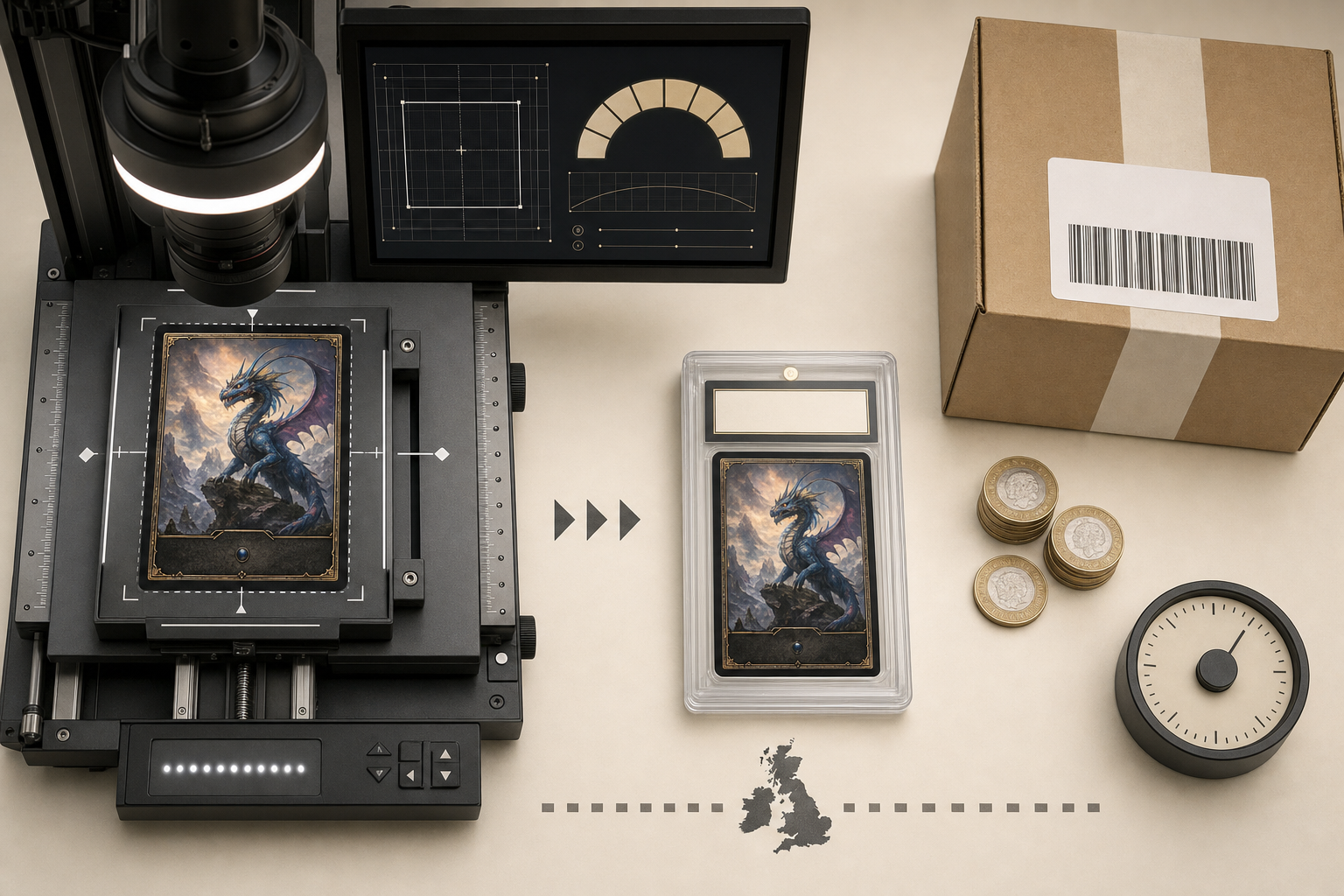
If you collect Pokémon cards in the UK and you’re thinking about getting them graded, this guide covers everything you need — what grading is, what it costs, how the 1–10 scale works, which cards are worth it, how to send your cards safely, and how to get started. It’s long, so use the contents to jump to what you need.
What is card grading?
Grading is an independent assessment of a card’s condition. A grading service examines the card, assigns a grade on a 1–10 scale, and seals it in a tamper-evident slab with a unique certificate. The result is a documented, verifiable statement of condition — not a guess and not just the seller’s word. If you’re new to the idea, our guide to raw vs graded cards explains the difference in full.
Why grade your cards?
- To sell. A verified grade removes a buyer’s biggest worry — condition — and graded cards typically sell for more than raw equivalents, especially near the top of the scale.
- To protect. A slab keeps a card in fixed condition, safe from handling, bending, light and damp.
- To prove. A grade backed by measurement gives you a permanent, checkable record of a card’s condition and authenticity.
Not sure if it’s right for a given card? We wrote an honest guide to whether grading is worth it.
The 1–10 grading scale
Grades run from 1 (heavily damaged) to 10 (as close to flawless as a card gets). In broad terms a 10 is “Gem Mint”, a 9 is “Mint”, 7–8 is near-mint with light wear, and below that reflects increasing wear or damage. “Gem Mint” is stricter than “Mint” because the card has to be excellent across every factor at once. We break the whole scale down in card grades explained.
What graders measure: centering, corners, edges and surface
A single grade is built from four things:
- Centering — how evenly the design sits within the borders, front and back. It’s fixed when the card is cut, so it can’t be improved — which is why it catches so many cards out. See why centering makes or breaks a grade.
- Corners — sharpness, and any whitening or rounding.
- Edges — cleanliness, and any chipping or wear (especially visible on dark borders).
- Surface — scratches, print lines, dimples and loss of gloss.
The lowest factor tends to limit the overall grade: a perfect card with one soft corner isn’t a 10.
How CALIBRE grades: measured, not guessed
There are three broad approaches to grading: a human judging the card by eye, an AI model predicting a grade from photos, and physical measurement. CALIBRE measures the card — border widths for centering, precise imaging for corners, edges and surface — so the grade is repeatable. The same card produces the same grade every time, and every measurement is recorded in your report. That’s a real advantage over grading by eye, where two graders can disagree on the same card. See exactly how it works, and how we compare to other approaches.
How much does grading cost in the UK?
CALIBRE keeps pricing flat and simple:
- Standard grading — £25 per card (7-day turnaround).
- Tracked, insured return postage — £5.95 per order.
There’s no upcharge for holos, textured foils or high-value cards. Full detail — including postage to us — is in how much does card grading cost.
How long does grading take?
Because we grade domestically, there’s no transatlantic shipping eating weeks off the clock. Standard turnaround is 7 days from receipt. We cap how many cards we take each week to protect those times rather than build a backlog.
UK grading vs shipping to the US
Sending cards overseas means international postage both ways, paying in dollars, possible customs charges, and weeks in transit. Grading at home avoids all of that — no customs, no currency conversion, and a card that never leaves the country. We compare the two in detail in UK vs US card grading.
Which cards should you grade?
You don’t need to grade a whole binder. The best candidates are cards with real value or demand that are also in strong condition — pack-fresh corners, clean edges, no surface marks, and good centering. Visibly damaged cards grade low, and a low grade rarely adds value. A good rule of thumb: grade the cards you’d be annoyed to lose value on. Our guide on whether grading is worth it goes deeper.
Authentication and spotting fakes
Counterfeit cards are common, and a fake won’t pass authentication. Before you spend money grading, it’s worth doing a few non-destructive checks — print pattern, finish, back colour, fonts and symbols. Our guide to spotting a fake card walks through them. CALIBRE includes authentication checks as part of grading, so a card that isn’t genuine won’t get a grade.
How to send your cards
Sleeve each card, place it in a semi-rigid holder, and pack it so it can’t bend — then send it on a tracked, insured service. You can also add a Royal Mail Tracked & Signed label at checkout and we’ll email you one to print. Full instructions are in our packaging and sending guide.
Verifying a grade
Every CALIBRE-graded card carries a unique certificate, and every grade is published to our public registry — so anyone can check that a grade is real and matches the card. If you’re buying a graded card, that verification is your protection against tampered slabs and faked labels. Here’s how to verify a certificate.
How to get started
- Pick the cards worth grading.
- Place your order online and pay securely.
- Package and post your cards to us.
- Track every step in your account, then get your sealed, certified card back.
There’s a step-by-step version in how to get your cards graded in the UK. Ready now? Start your order →
Frequently asked questions
How much does it cost to grade a Pokémon card in the UK?
CALIBRE charges a flat £25 per card for standard grading (7-day turnaround), plus £5.95 tracked, insured return postage per order. There’s no upcharge for holos or high-value cards.
How long does grading take?
Standard grading is a 7-day turnaround from when we receive your card. Postage time to us is on top of that, so send on a tracked service.
Is it worth grading my cards?
It’s worth it when a verified grade adds more than it costs — for cards you’re selling, insuring or keeping long-term in proven condition. It’s usually not worth it for low-value commons or visibly damaged cards.
Do I have to send my cards to the US?
No. CALIBRE grades domestically in the UK, so there’s no international shipping, no customs, and no weeks in transit — your cards never leave the country.
What does Gem Mint mean?
Gem Mint is the top grade (10). It means the card is excellent across every factor at once — sharp corners, clean edges, a flawless surface and near-perfect centering.
How do I know a grade is genuine?
Every CALIBRE grade has a unique certificate and is published to our public registry. You can look up the certificate to confirm the grade matches the card, and the slab is tamper-evident.