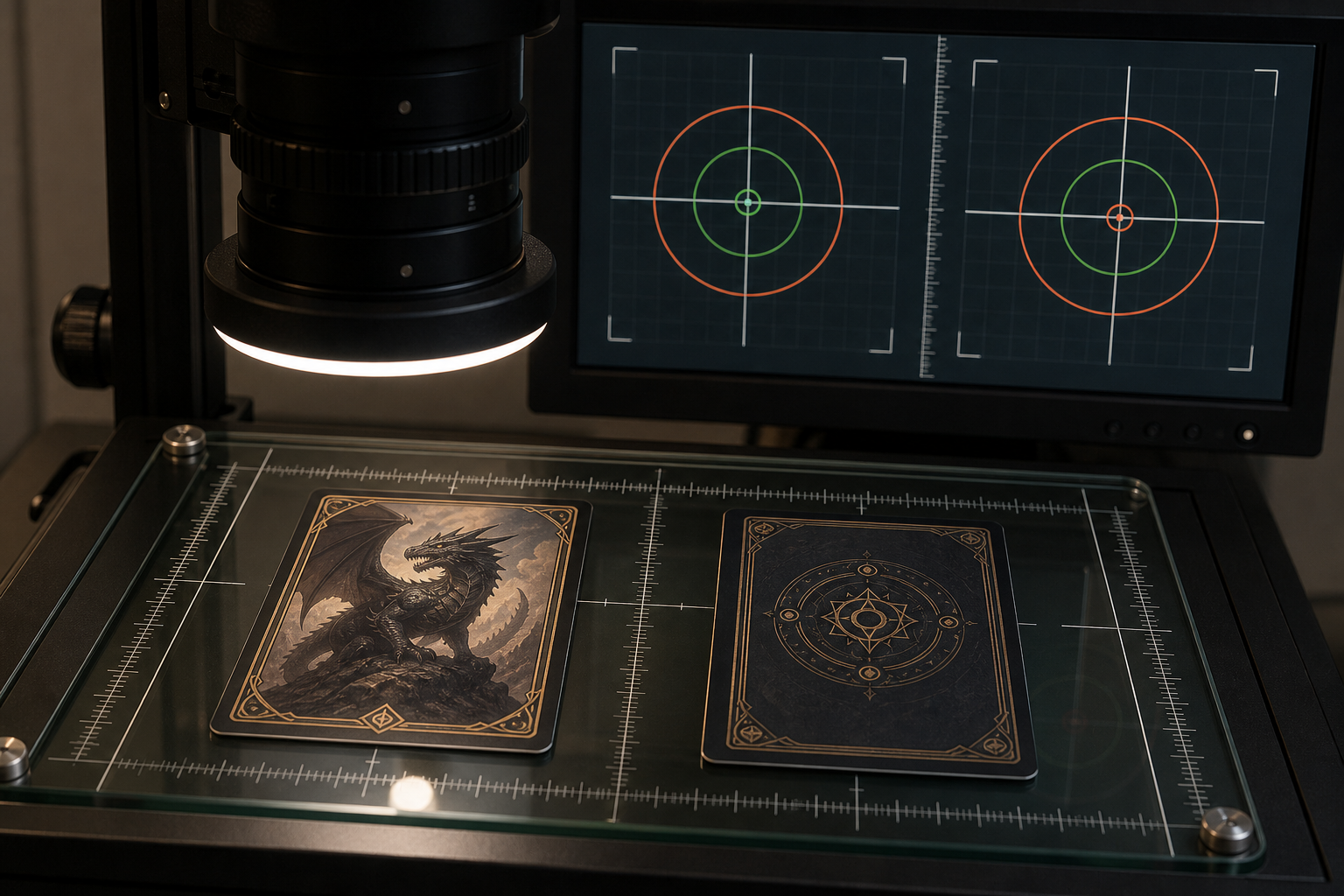
Of all the things that decide a card’s grade, centering is the one collectors underestimate most. Here’s what it is, how it’s measured, and why it can be the difference between a 9 and a 10.
What centering means
Centering is how evenly the printed design sits within the card’s borders. In a perfectly centred card, the border is the same width on the left and right, and the same top and bottom — on both the front and the back. Cards are cut from large printed sheets, and small shifts in that cut leave one border wider than the one opposite it.
Why it matters so much
You can have flawless corners, clean edges and a perfect surface, but if the design is noticeably off to one side, the card won’t reach the top grade. Because centering is fixed at the moment the card is cut, it’s the one factor you can’t improve — which is exactly why high grades on poorly centred cards are rare and valuable.
Front and back both count
A card can look well-centred on the front and be badly off on the back. Grading considers both faces, so it’s worth checking the reverse before you assume a card is a top-grade candidate.
How CALIBRE measures it
Rather than eyeballing the borders, CALIBRE measures them. The card is imaged and the border widths are measured precisely on both faces, so centering is a number, not an opinion — and the same card produces the same result every time. It’s recorded in your report alongside corners, edges and surface. See how it works.
Think you’ve got a well-centred gem? Start your order →