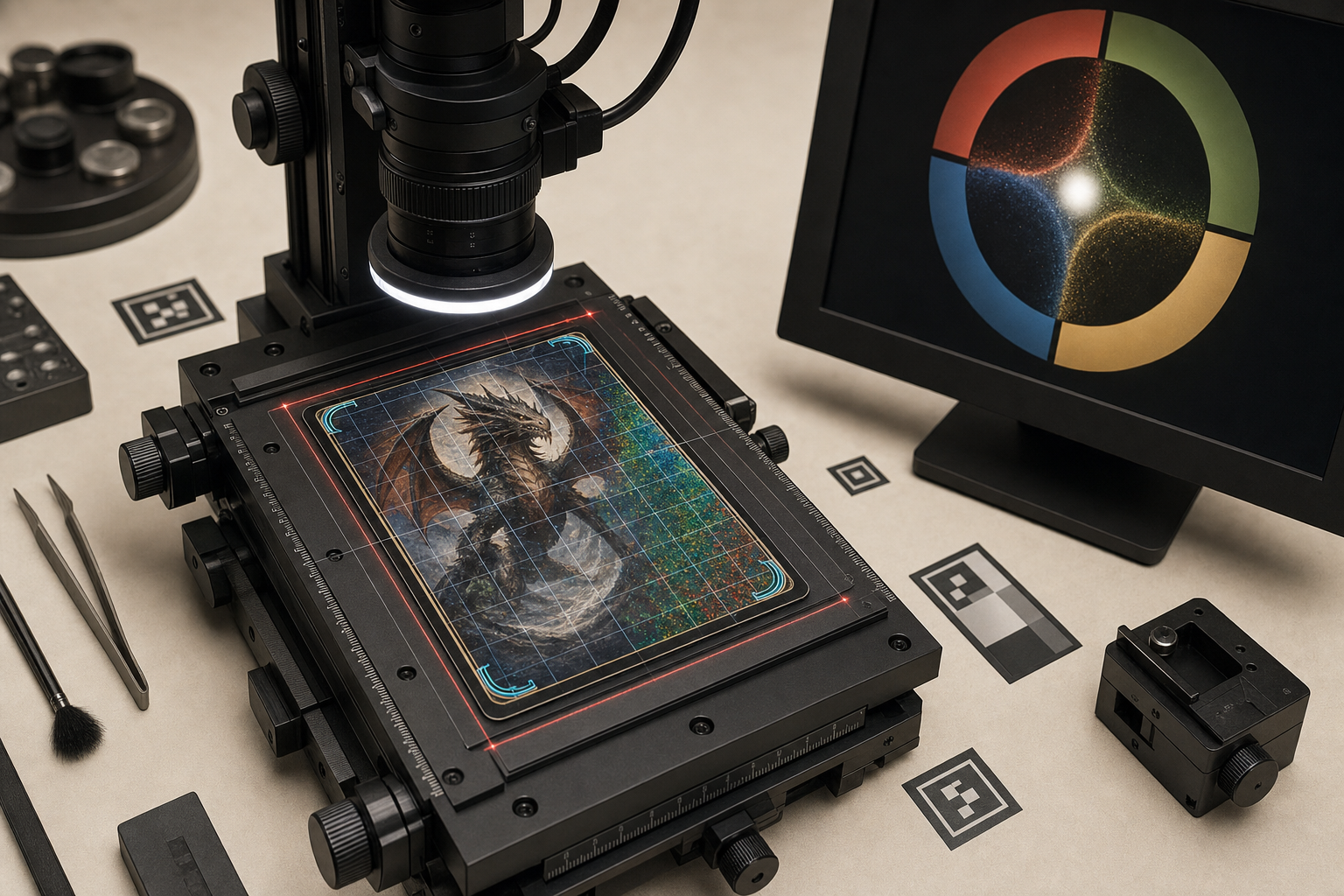
“Grading” can mean very different things depending on who’s doing it. This guide explains how card grading actually works — what’s assessed, how the four factors combine into a single grade, and why measuring a card produces a more consistent result than judging it by eye or predicting it with AI.
What grading involves
At its core, grading answers one question: what condition is this card in? To answer it consistently, a grader has to assess four separate things — centering, corners, edges and surface — and combine them into a single number on a 1–10 scale. The detail is in how each of those is judged, and how reliably. New to the scale itself? Start with card grades explained.
Centering
Centering is how evenly the printed design sits within the card’s borders — equal margins left and right, top and bottom, on both faces. Cards are cut from large sheets, and small shifts in that cut leave one border wider than the one opposite. Because it’s set at the moment of cutting, centering can’t be improved, which makes it the factor that most often keeps a card off the top grade. We cover it in depth in what is centering.
Corners
Corners are usually the first thing to wear. Even careful handling can soften a sharp corner or bring faint whitening to the tip. A grader looks for crisp, sharp corners with no rounding or fraying — and since there are four, the weakest one tends to set the standard.
Edges
Edges pick up chipping and whitening, which shows instantly on dark-bordered cards. Clean, unbroken edges are the goal; nicks and whitening pull the grade down.
Surface
Surface covers scratches, print lines, dimples, indentations and any loss of gloss. Holo and foil finishes can show surface issues more readily. It’s the factor most affected by how a card has been stored and handled.
How four factors become one grade
The four factors are assessed separately, then combined — and crucially, the lowest factor tends to limit the overall grade. A card that’s a 10 on three factors but a 7 on corners isn’t a 10. That’s why a single number can hide a lot, and why a good grading report shows the subscores, not just the headline. A flawless card with one soft corner grades very differently from one that’s marginal everywhere.
Why human grading varies
Traditional grading asks a person to make those judgements and combine them. People are remarkably good at it — but they’re still people. Lighting, fatigue, the order cards are seen in, and ordinary human variation all nudge a borderline card one way or the other. A card on the line between a 9 and a 10 is exactly where two graders are most likely to disagree — and that inconsistency has real cost, which is why some collectors resubmit the same card hoping for a better number. We unpack this in why two graders can disagree.
Why AI prediction isn’t measurement
Some services use AI to predict a grade from photos. It’s fast, but a prediction is an estimate of what a grade “should” be based on patterns in past cards — not a direct measurement of your specific card. Predictions can be confidently wrong and are hard to explain. Measurement is different: it produces numbers you can see and check. Our market comparison sets the approaches side by side.
How CALIBRE measures
CALIBRE doesn’t ask a person to judge the card, and it doesn’t predict from a model — it measures. Centering comes from the actual border widths; corners, edges and surface are assessed from precise imaging. Because the inputs are measurements rather than impressions, the grade is repeatable: the same card produces the same grade every time. See the full process in how it works.
Your grading report
Every grade comes with a report showing the overall grade, the four subscores, and the measurements behind them — a transparent record rather than a verdict you have to take on trust. Each report ties to a unique certificate published in our registry, so any grade can be verified. Here’s how to verify a certificate.
Frequently asked questions
What do graders actually look at?
Four things: centering (how evenly the design sits in the borders), corners, edges and surface. Each is assessed separately and combined into one grade, with the weakest factor usually limiting the result.
Why can the same card get two different grades?
When grading is done by eye, human factors — lighting, fatigue, variation — nudge borderline cards one way or the other. Measuring the card removes that inconsistency, so the same card produces the same grade every time.
Is AI grading the same as measurement?
No. AI predicts a grade from photos based on patterns in past cards; measurement assesses your specific card directly and produces numbers you can check. CALIBRE measures rather than predicts.
What’s the most important factor?
It varies by card, but centering catches the most people out because it’s fixed when the card is cut and can’t be improved. The lowest of the four factors usually limits the overall grade.
Does my grade come with proof?
Yes. Every grade includes a report with the subscores and measurements, plus a unique certificate published to the public registry so the grade can be independently verified.
Want to see it on your own cards? Start your order →