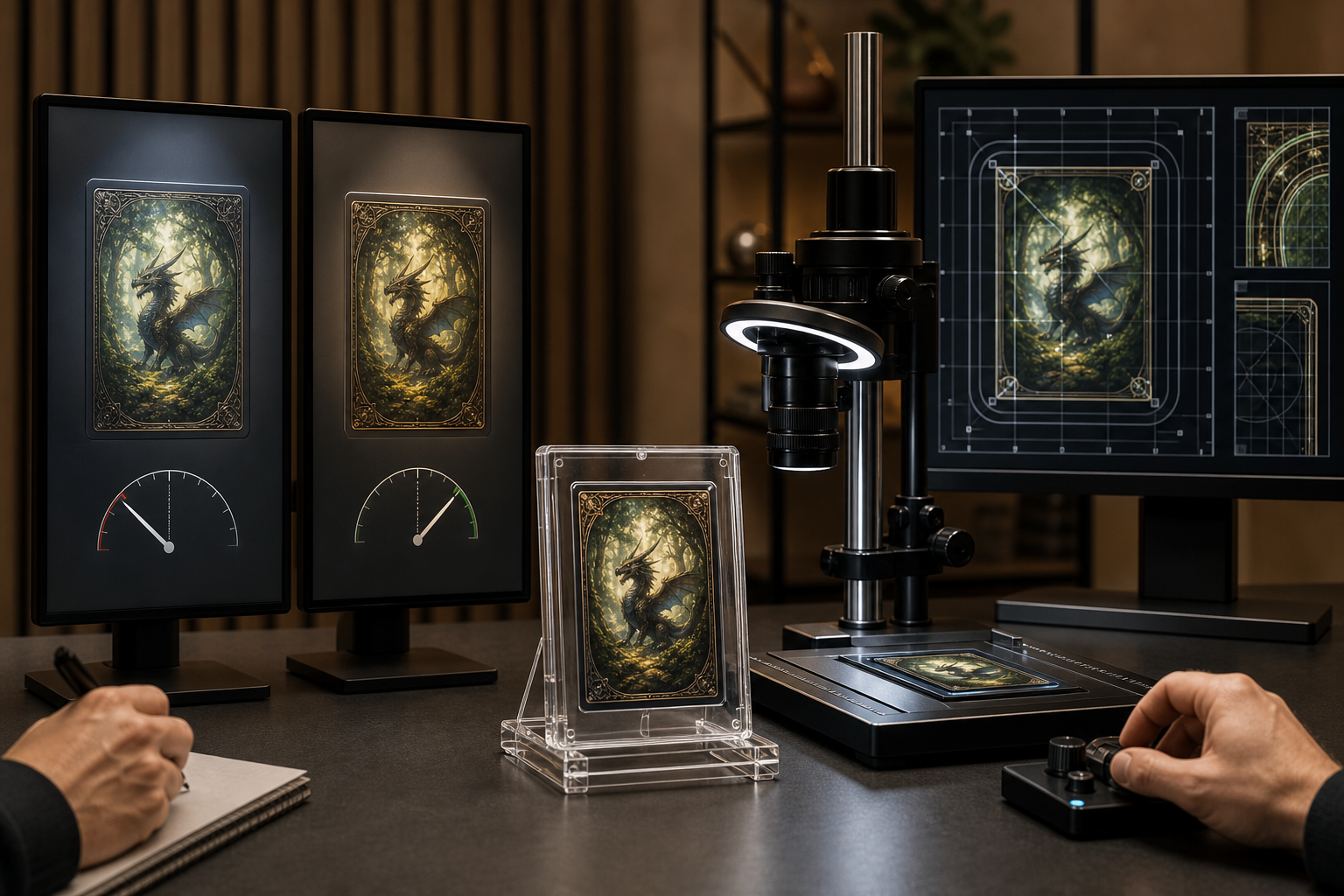
Send the same card to two human graders and you can get two different grades. That’s not a scandal — it’s a known limitation of grading by eye. Here’s why it happens, and how measurement removes it.
Why opinions diverge
Traditional grading asks a person to judge centering, corners, edges and surface and combine them into one number. People are remarkably good at this — but they’re still people. Lighting, fatigue, the order they see cards in, and simple human variation all nudge a borderline card one way or the other. A card on the line between a 9 and a 10 is exactly where two graders are most likely to disagree.
The cost of inconsistency
Inconsistency is expensive. The gap between a 9 and a 10 can be a large gap in value, so a grade that could have gone either way introduces real uncertainty — and it’s why some collectors resubmit the same card hoping for a better number.
How measurement fixes it
CALIBRE doesn’t ask a person to judge the card — it measures it. Centering comes from the border widths; corners, edges and surface are assessed from precise imaging. Because the inputs are measurements rather than impressions, the same card produces the same grade every time, and every measurement is recorded in your report. See exactly how it works, or read how we measure centering.
Proof you can check
Every grade we issue is recorded with its measurements and published with a verifiable certificate. Browse the full population of cards we’ve graded in the registry.