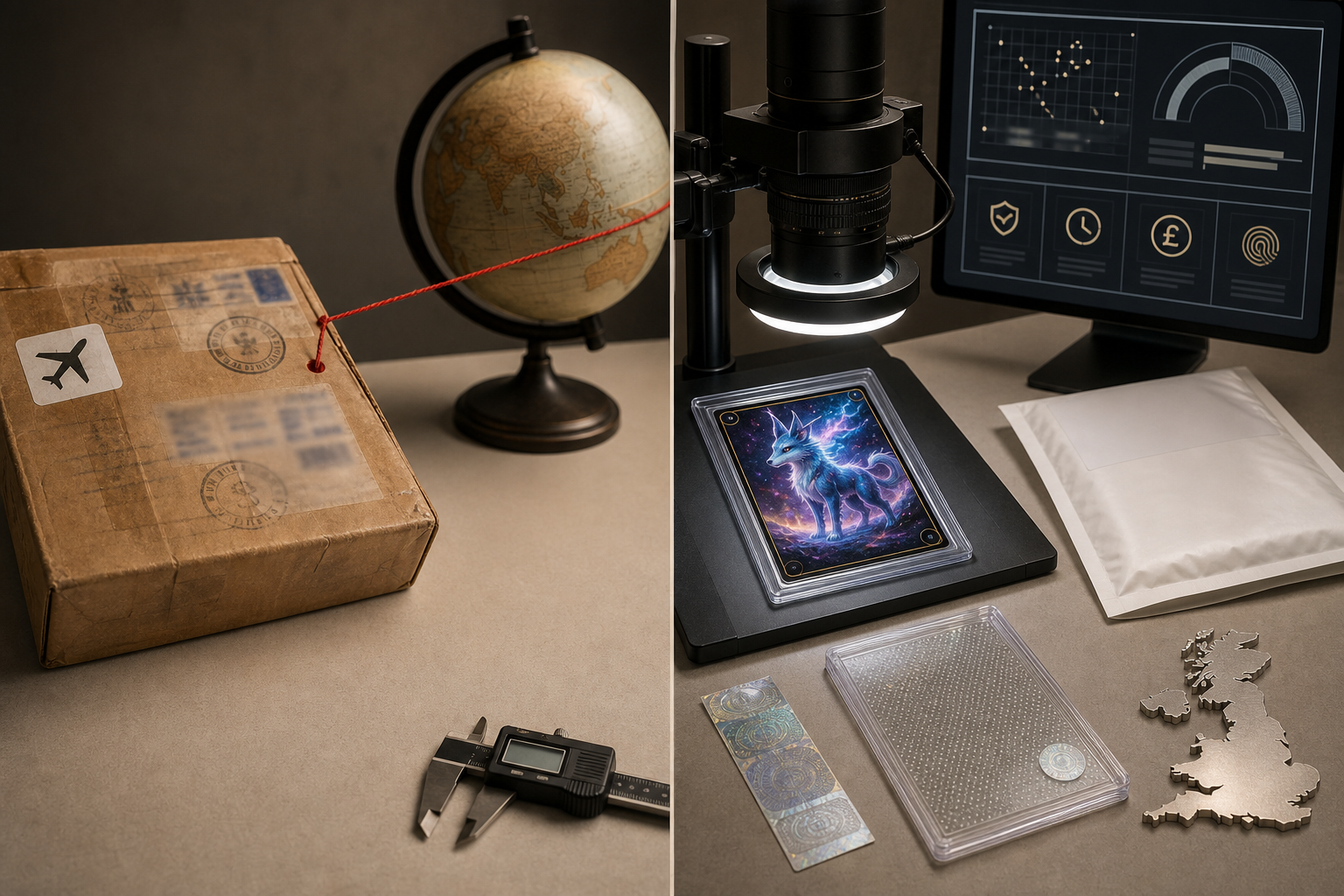
If you’ve decided to grade your Pokémon cards, the next
question is who should do it. There are more options than there used to be
— including, for the first time, serious grading done start-to-finish in
the UK. This guide covers exactly what to look for in a Pokémon card
grading company, the questions worth asking before you post anything, and how to
tell a genuine grader from a logo on a slab.
New to grading entirely? Start with our complete guide to Pokémon card grading in the UK — it explains what grading is, how the 1–10 scale works and which
cards are worth it. This article assumes you’ve already decided to grade and
focuses on picking the right company.
Why grade with a UK company?
For years, getting a Pokémon card graded to a recognised standard meant
shipping it across the Atlantic and waiting — sometimes months — to
get it back. A UK grading company removes most of the friction:
- No transatlantic risk. Your card never leaves the country.
No customs, no import charges on the return, no parcel sitting in a depot
overseas for weeks. - Faster, cheaper postage. Domestic tracked, insured postage
costs a fraction of international shipping, and the round trip is days rather
than weeks. - Real support. Same time zone, same consumer protections,
and a company you can actually reach if something goes wrong.
We go deeper on the trade-offs in UK vs US card grading, but for most UK collectors the maths now favours grading at home.
What to look for in a Pokémon grading company
Not all grading is equal. A slab and a number on it are easy to produce; a
grade you can actually trust is not. Here’s what separates a serious
Pokémon card grading company from the rest.
1. Consistency you can trust
The whole point of a grade is that it means the same thing every time. The
risk with traditional grading is that it leans on human eyes — and humans
are inconsistent, especially across busy days and different graders. Ask how a
company actually arrives at a grade. Is it one person’s opinion, an AI’s guess
at what a card “looks like”, or a repeatable physical measurement? We explain why
that distinction matters in AI grading vs measurement.
2. Turnaround that’s actually stated
A good company tells you a clear turnaround and measures it from the day your
cards arrive — not a vague “weeks to months”. Be wary of services that
won’t commit to a timeframe. See how long card grading takes for what’s realistic.
3. Transparent, flat pricing
Pricing should be simple to understand before you commit. Watch for value-based
tiers (where you pay more to grade a more valuable card for the same work),
express premiums, and surprise fees at checkout. A flat per-card price is the
honest model. Our guide to grading costs in the UK breaks down what you should expect to pay.
4. Real authentication
Pokémon is one of the most counterfeited card categories in the world,
and fakes have got good. A grading company worth using authenticates every card
— not just eyeballs it — and will fail anything it can’t verify. If a
service grades condition but says nothing about authenticity, that’s a gap. Learn
how fakes are spotted and what a real
authentication pass involves.
5. A slab and report worth having
The slab protects the card; the report explains the grade. The best companies
give you a tamper-evident case and a detailed report showing how the
grade was reached — centring, corners, edges and surface — rather
than just a bare number. That report is what a future buyer trusts.
6. Insurance, tracking and safe returns
You’re posting something valuable to a stranger. A credible company insures
your cards while they’re in its care, returns them on a tracked and insured
service, and is clear about who carries the risk at each step. Don’t send a
grail to anyone who can’t tell you exactly how it’s covered.
7. Verifiable certificates and a public registry
Every grade should be independently verifiable. Look for a unique certificate
number you (or a buyer) can check online, and ideally a public registry of graded cards. If a grade can’t be verified, it’s just a sticker. Here’s
how certificate verification works.
Red flags to watch for
- No clear method. If a company won’t explain how it grades,
assume the answer is “inconsistently”. - Grades but doesn’t authenticate. A condition grade on a fake
card is worthless — or worse. - Vague timeframes and no fixed price. Both are signs of a
process that isn’t under control. - No verifiable certificate. A slab nobody can check protects
nobody. - Unclear on insurance and returns. If they can’t tell you how
your cards are covered, don’t post them.
How CALIBRE does it
CALIBRE is a UK Pokémon card grading company built specifically to
close those gaps. The core idea is in our name and our motto —
measured, not guessed:
- No human opinion. Every card is physically measured
— centring, corners, edges and surface — so the same card gets the
same grade every time, not a different number on a different day. - Authentication on every card. We verify each card before we
grade it, using transmitted light, weight, UV and other passes. Anything we can’t
authenticate doesn’t get a grade. - Graded in the UK, fast. Our lab is in the UK and we target a
7-day turnaround from arrival — no transatlantic round trip. - Flat, honest pricing. One per-card price. No value-based
upcharges, no holo premiums, no surprises at checkout. - Tracked, insured, verifiable. Your cards come back on a
tracked and insured service, sealed in a tamper-evident slab, each with a unique
certificate and a full report you can look up in our public registry.
If that’s the kind of grading you’re after, you can start an order in a couple of minutes.
What it costs and how long it takes
UK grading is typically far cheaper than the all-in cost of shipping abroad
once you count international postage, insurance and potential import charges. For
the full picture, see our breakdowns of what grading costs in the UK and how long grading takes. CALIBRE charges a flat per-card rate and targets a 7-day turnaround from
the day your cards reach us.
Sending your cards safely
How you pack your cards matters as much as who grades them. Sleeve each card,
use a top-loader or semi-rigid holder, and post on a tracked, insured service.
Our step-by-step guide on how to package and send your cards walks through it so nothing gets damaged in transit.
Getting started
Once you’ve chosen a company, getting started is quick: build your order,
choose a turnaround, and post your cards. With CALIBRE you can begin your submission online now, and track every card through grading in your account. Still deciding
whether it’s worth it? Read is card grading worth it.
Frequently asked questions
Which companies grade Pokémon cards in the UK?
UK collectors can now grade domestically rather than shipping to the US.
CALIBRE is a UK-based Pokémon grading company that measures every card
physically, authenticates it, and returns it sealed with a verifiable
certificate — all without your card leaving the country. When comparing
companies, focus on method, authentication, turnaround, pricing and whether
grades are independently verifiable.
Is it better to grade Pokémon cards in the UK or send them to PSA in the US?
For most UK collectors, grading in the UK is faster and cheaper once you
account for international postage, insurance and possible import charges —
and your card never leaves the country. US grading can make sense for specific
resale markets, but the convenience and cost gap has narrowed sharply. See our
UK vs US grading comparison for the full
trade-offs.
How much does it cost to grade a Pokémon card in the UK?
UK grading is generally much cheaper than the all-in cost of grading abroad. A
good company charges a clear, flat per-card price with no value-based upcharges.
Our UK grading cost guide explains what to
expect.
How long does Pokémon grading take?
It varies by company. A serious grader states a clear turnaround measured from
when your cards arrive. CALIBRE targets 7 days from arrival. More on realistic
timeframes in how long grading takes.
Are graded Pokémon cards worth more than raw cards?
Usually, yes — a verified grade removes a buyer’s biggest worry
(condition and authenticity), and high-grade cards typically sell for more than
raw equivalents. The premium depends on the card and the grade. See is grading worth it and raw vs graded cards.
How do I know a Pokémon grading company is legitimate?
Check that it explains its grading method, authenticates every card, states a
clear turnaround and price, insures your cards in transit and in its care, and
issues a unique certificate you can verify online — ideally backed by a
public registry. If any of those are missing, be cautious.
Ready to grade? Start your order or get in touch if you have a question first.