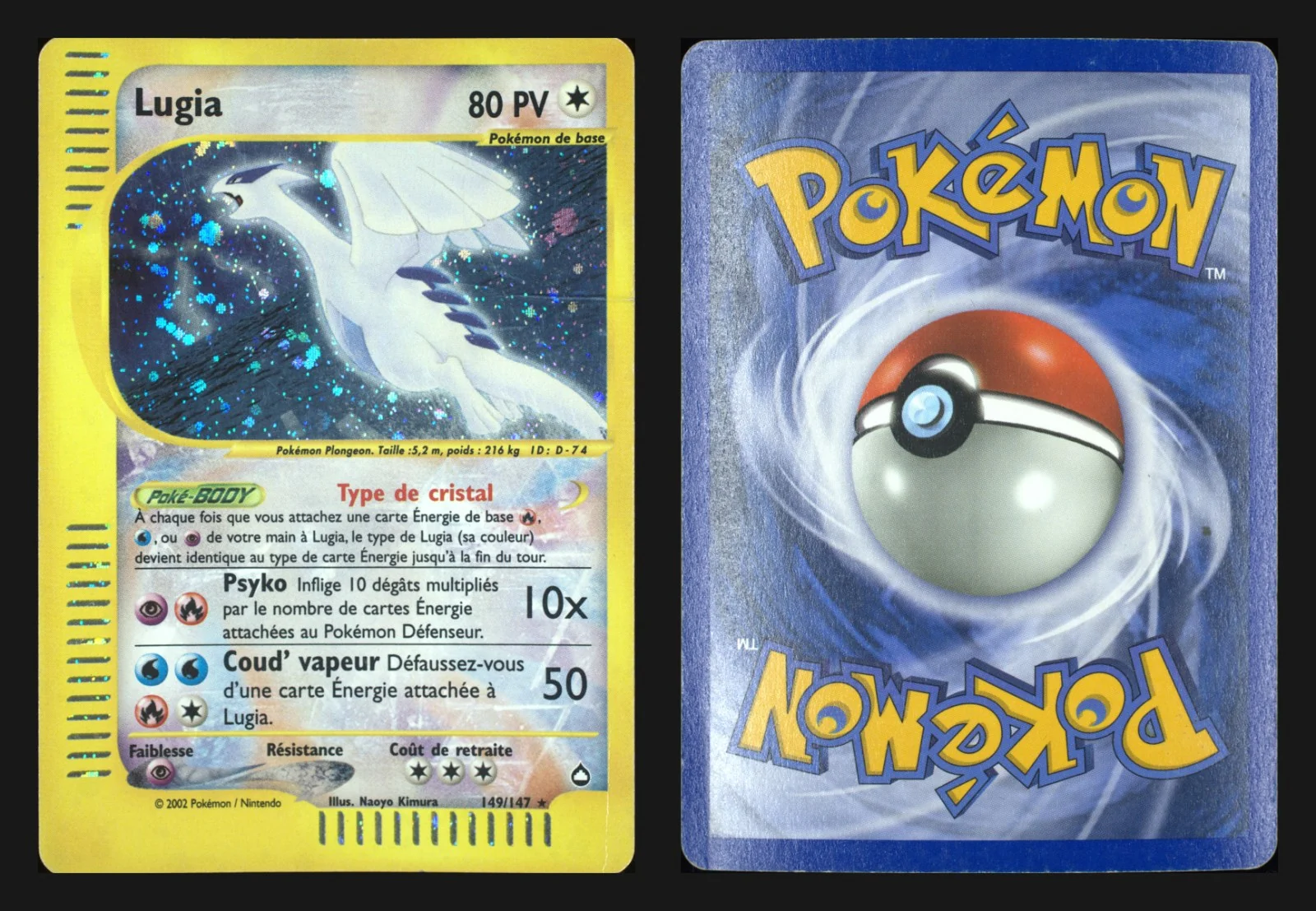
The card passed every authentication check. The numbers below are why it still graded a 4.
At a glance
- Card: Crystal Lugia, Aquapolis (French), 149/147
- Authentication: passed every check
- Front grade: 4.0 · Back grade: 7.5
- Overall grade: 4
A French Aquapolis Crystal Lugia came through our lab recently. It is one of the most sought-after cards of the e-Card era, and it is genuine. It also graded a 4, because it had been badly water-damaged. This is how that damage turned into a number, using the actual measurements stored for this card.
First: is it real?
Authentication comes before grading, and it is separate from condition. For this Lugia:
- Carbon layer: consistent with verified cards from the same set and period (early 2003).
- Size: 63 × 88 mm, with no indication of trimming.
- Alterations: examined under 365 nm and 395 nm ultraviolet light, with no visible signs of alteration.
- Weight: 1.77 g, within the 1.75–1.80 g range expected for genuine cards of this type.
- Card stock and typeface: consistent with verified cards from this era and set.
- Holo pattern and texture: examined under photometric light and consistent with genuine e-Card era Crystal holos.
- e-Reader dot code strips: sharp and well defined along the left and bottom edges under magnification, consistent with genuine e-Card era printing.
A water-damaged card can be completely genuine. The damage is the reason for the grade. It is not a doubt about the card.
What water does to a card
A Pokémon card is layered paper. When it gets wet the layers swell unevenly, and once it dries they do not return to where they were. What is left is a card that no longer sits flat, with ripples, creases where the stock buckled, and a rough surface where the finish should be smooth.
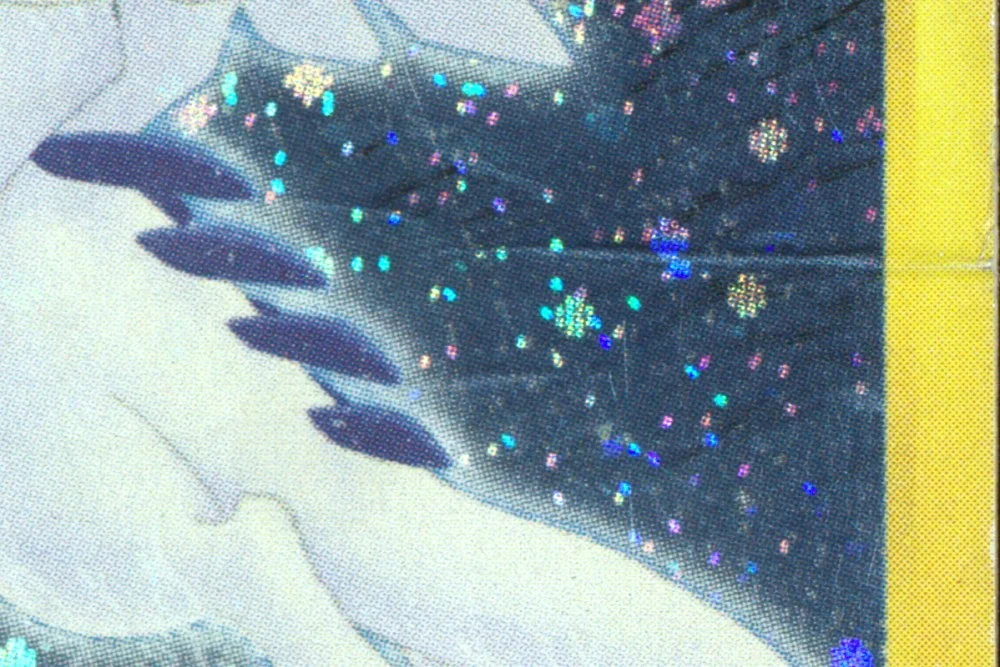
You can see all of that here without any instruments. The outline of the front is no longer straight. Creases run across the holo and the text box:
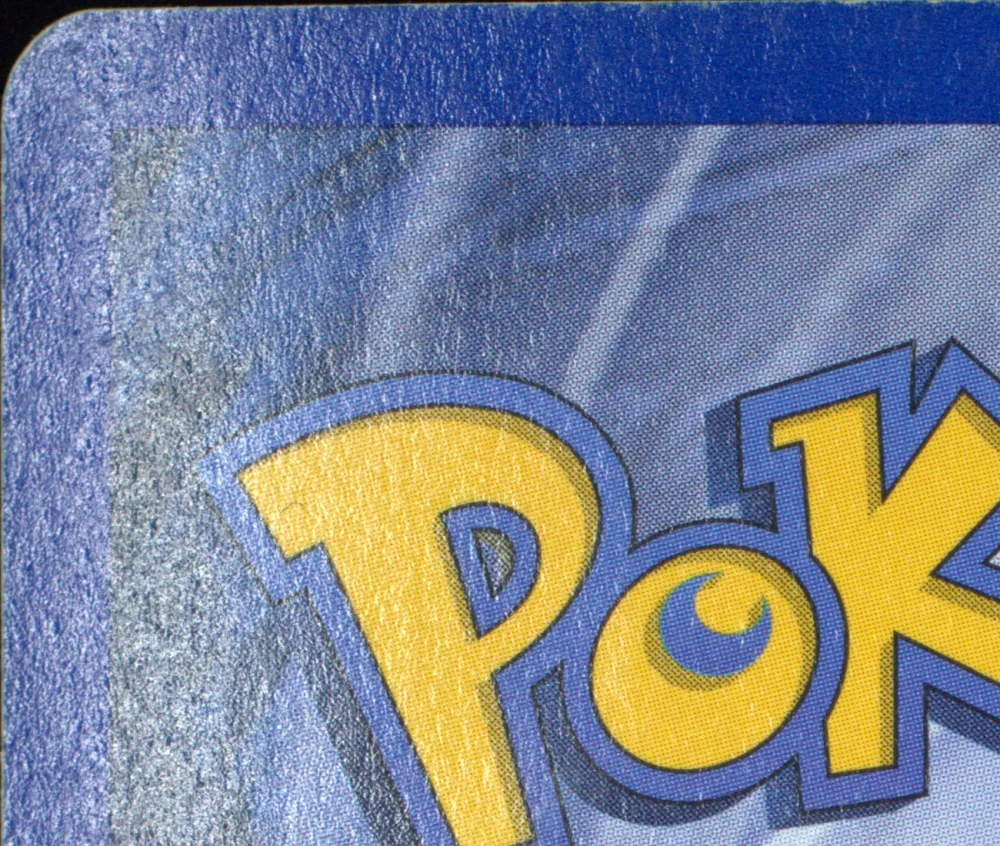
On the back, the left border should be smooth, solid blue. It is pitted and mottled instead:
How we measured it
Looking is not measuring. Every face we grade is photographed under four lights placed at a very low angle, just a few degrees above the surface, one from each side. We call them North, East, South and West, after their positions in the rig. There is also a normal, even light for the print itself.
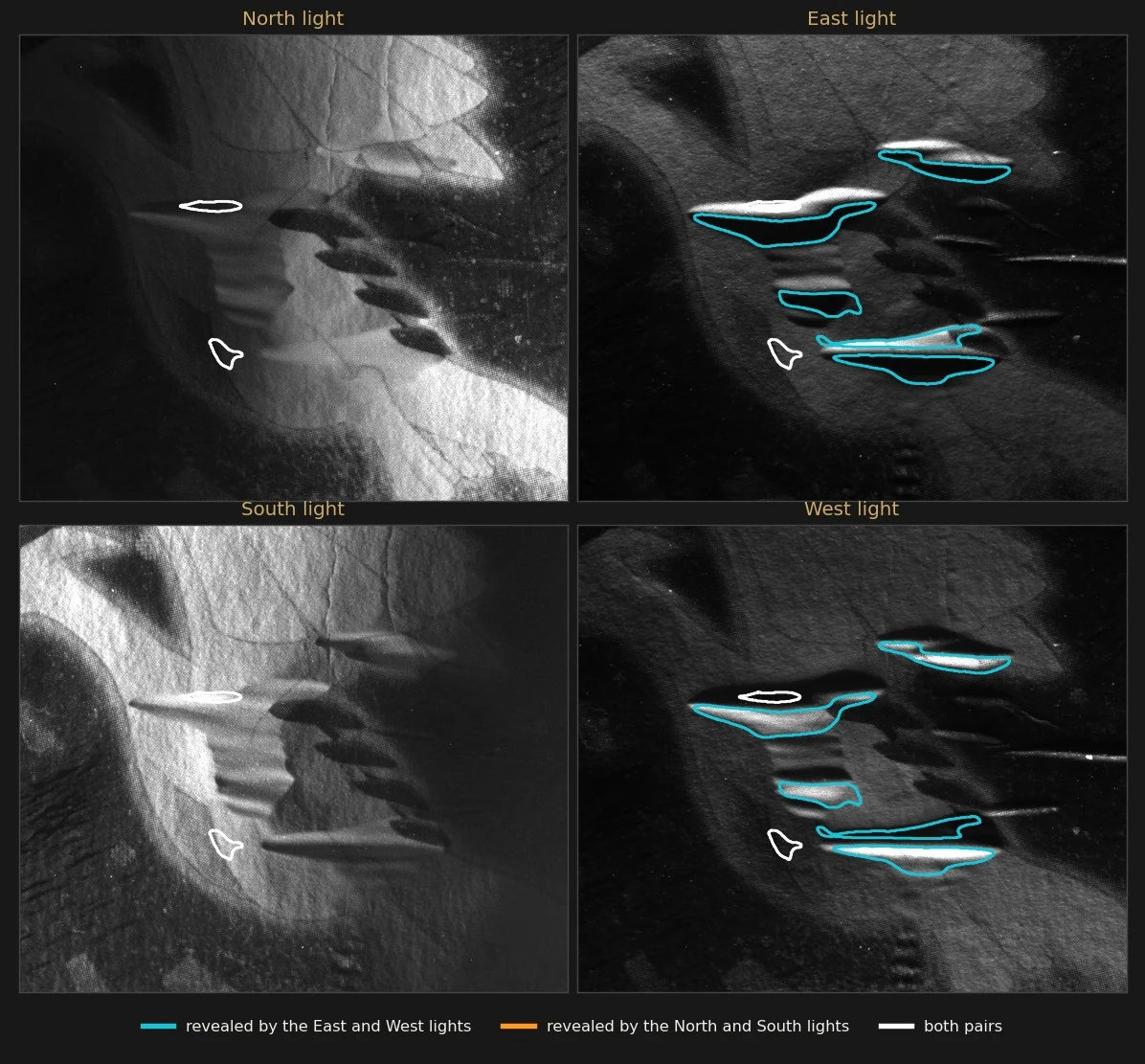
Low-angle (raking) light is the opposite of a flattering photograph. On a flat surface the light slides evenly across. Wherever the surface ripples, creases or dents, the side facing the light catches it and the far side falls into shadow. Here is one patch of this card’s front under each of the four lights:
From four photographs to one map
Printed artwork reflects light the same way whichever side it is lit from. A slope does not. So we subtract each light from the one opposite it, East minus West and North minus South, after scaling each by the card’s own average brightness. The printing cancels out, and the tilt of the surface is what remains. We then remove the card’s gentle overall bend and combine the two differences into a single slope value for every point on the card.
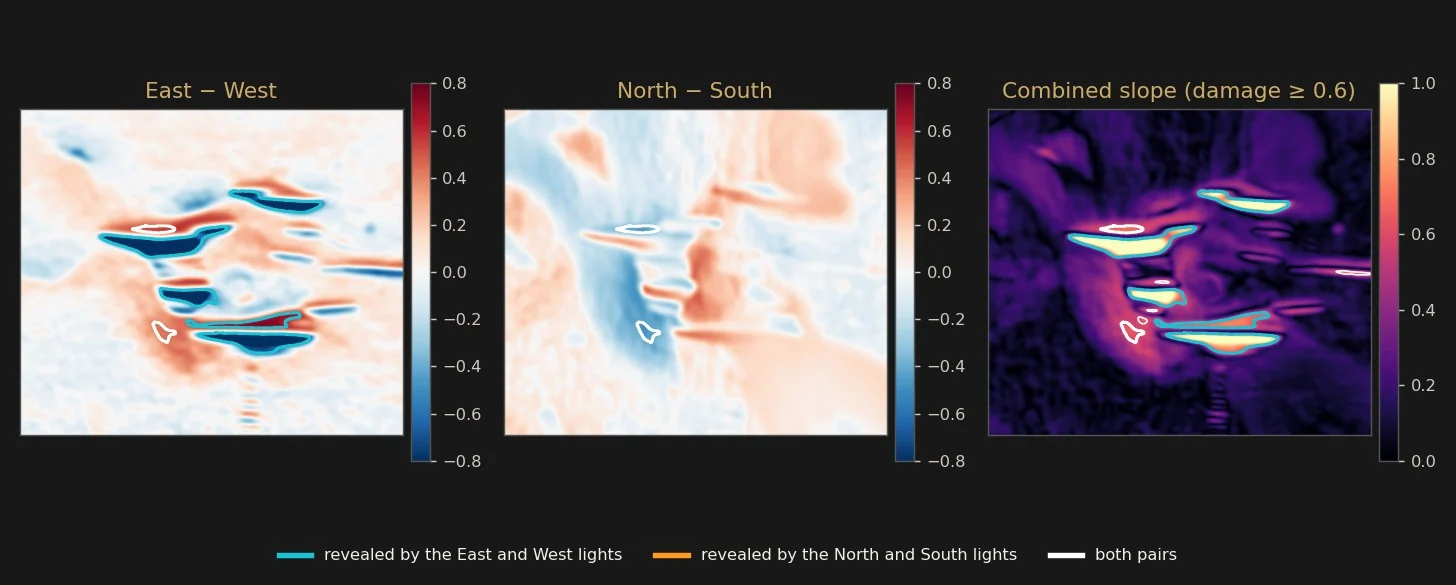
Any connected patch where the slope passes the threshold and covers more than a square millimetre counts as damage, and its area is measured. On the clean cards we have tested, including holographic ones, this measurement finds nothing at all.
Which lights see what
Dents and creases show up best to the pair of lights that shine across them, so different damage lights up different pairs:
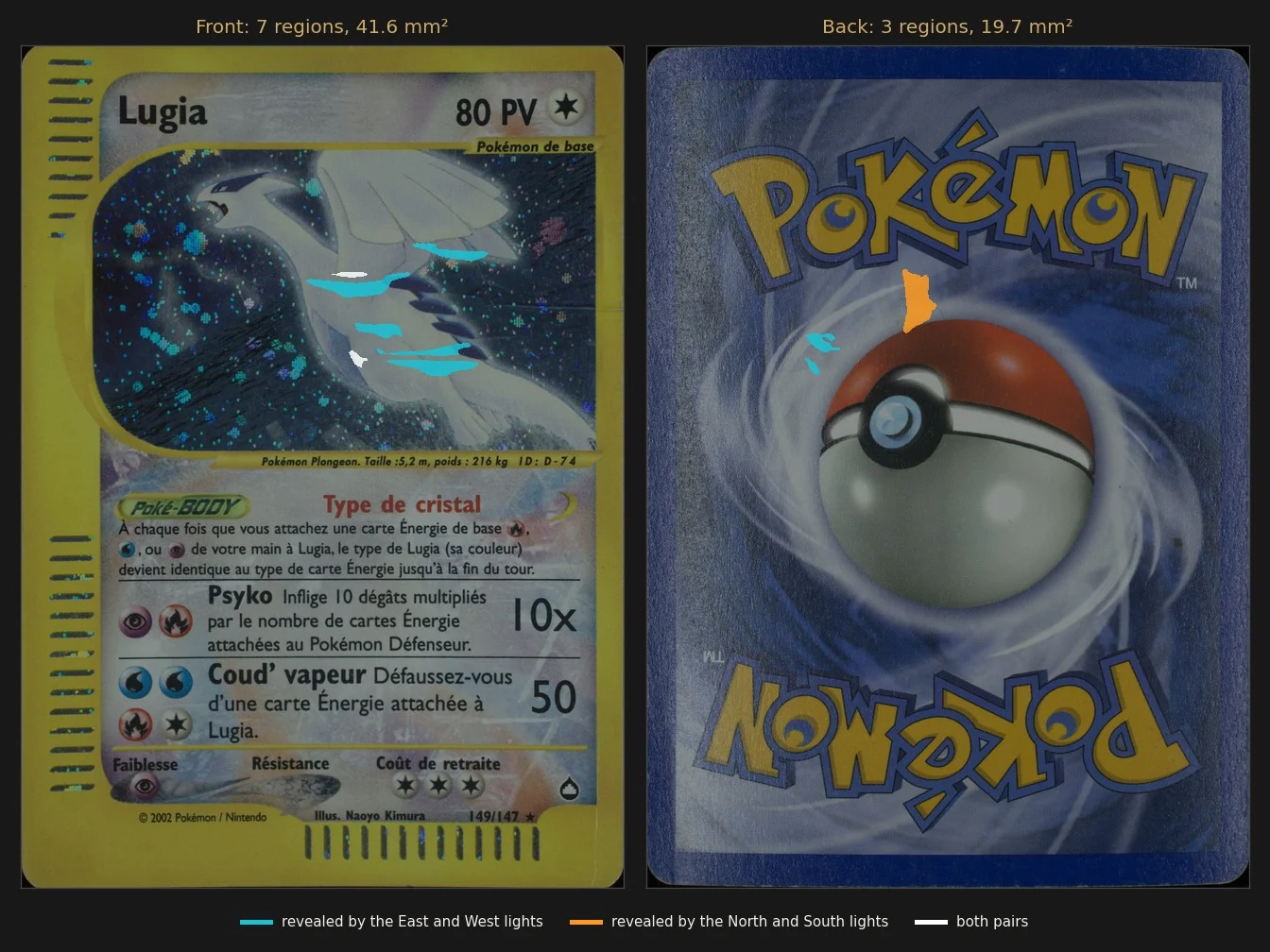
- Front: seven regions totalling 41.6 mm². The East and West lights reveal all seven; two of them are also seen by the North and South pair. The largest is a band about 2.6 mm wide and 11 mm long. Add two scratch-like marks (the longest about 7 mm) and the front’s surface damage is 49.8 mm² in all.
- Back: three regions totalling 19.7 mm². The largest, a 14.6 mm² patch at the top of the Poké Ball, is revealed by the North and South lights instead. The two smaller regions to its left show in East and West.
These pictures are made from the frames stored for this card, with the same calculation the grade uses, and they add up to the same 41.6 mm² and 19.7 mm².
One honest limit: this measures slope, not depth. It tells us where the surface is distorted and by how much area, not how many microns deep a dent or crease is.
From square millimetres to a grade
The surface grade starts at 10 and loses 0.12 of a point for every square millimetre of damage.
- Front: 10 − (0.12 × 49.8) = 4.0
- Back: 10 − (0.12 × 19.7) = 7.6
Fifty square millimetres is less than 1% of the face of the card, but it sits across the middle of the artwork, and at this weighting it adds up quickly.
| Centering | Corners | Edges | Surface | Face grade | |
|---|---|---|---|---|---|
| Front | 10 | 9.2 | 9.4 | 4.0 | 4.0 |
| Back | 9.0 | 9.0 | 8.1 | 7.6 | 7.5 |
Why the overall is a 4, not an average
A card is only as good as its weakest dimension, so a face is graded on its lowest measured subgrade, not the average of its four. On the front, centering 10, corners 9.2 and edges 9.4 do not make up for a surface of 4.0. Both faces are graded, and the card takes the lower of the two. That is why a back that graded 7.5 does not lift the card above 4.
What a 4 tells you, and what it doesn’t
- It tells you the card has significant physical damage, and our measurements point to where it is, square millimetre by square millimetre.
- It does not tell you the card is fake, trimmed or altered. This one is none of those.
- Every card we grade gets a public report with the same measurements and photographs, so the number can be checked rather than taken on trust.
Want your cards measured like this? Submit them for grading.