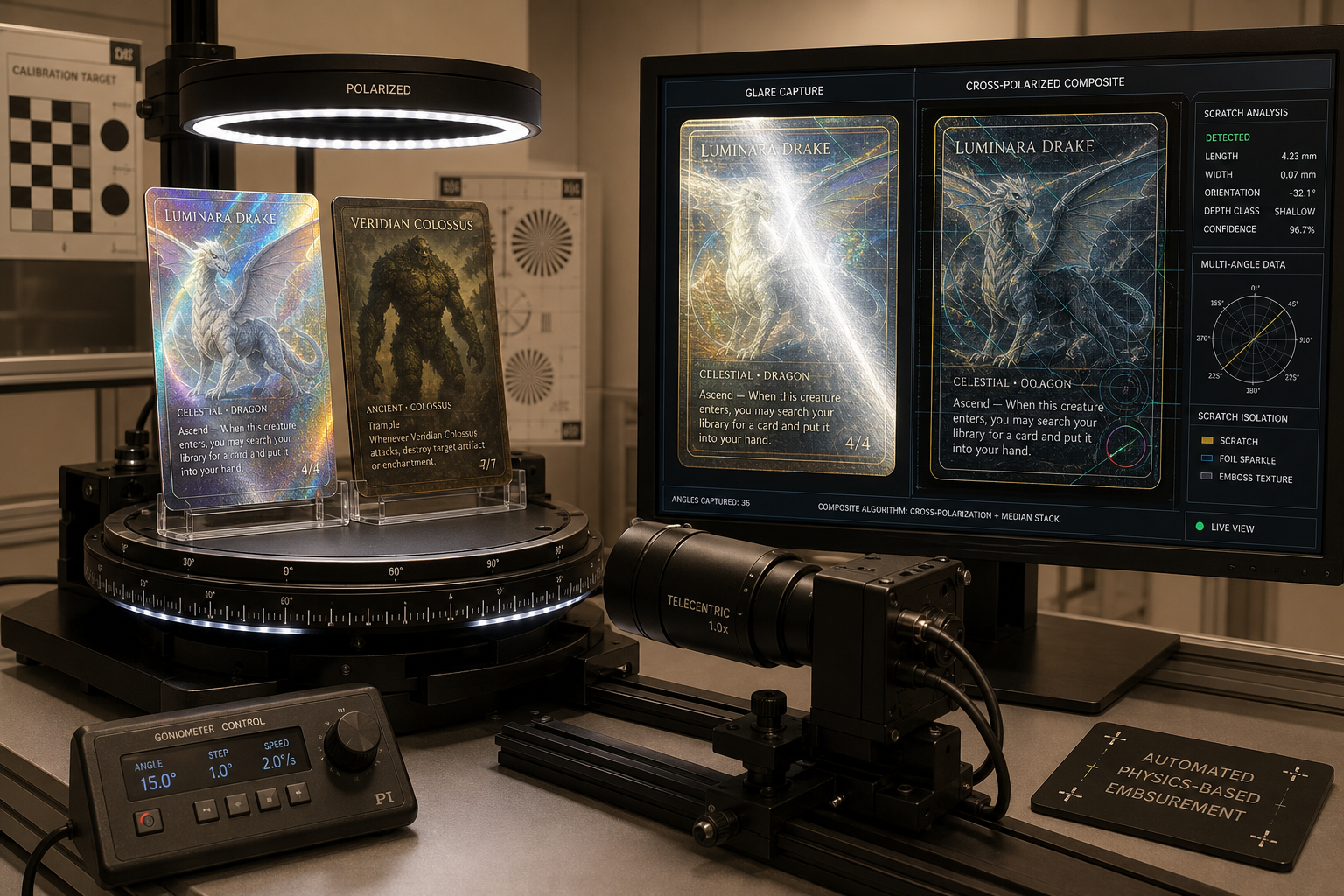
Holo, reverse-holo and the new wave of textured special-art cards are the ones collectors chase — and the ones that are hardest to grade consistently. The very shine that makes them desirable is also what hides wear, throws off the eye, and confuses photo-based grading. Here’s why foils are such a problem, and how measuring a card sees through the glare.
Shine is the enemy of a consistent read
A foil surface doesn’t reflect light evenly. Tilt a holo a few degrees and the whole card changes — bright bands sweep across it, the artwork flares, and a hairline scratch that was obvious a second ago disappears into the glare. That sensitivity to angle is exactly what makes grading by eye unreliable on holos: what you see depends on how you happen to be holding the card and where the light is.
It cuts both ways. Glare can hide genuine scratches, so a worn card looks cleaner than it is. And the foil’s own pattern — the lines and sparkle baked in at manufacture — can be mistaken for scratches, so a mint card looks damaged. Two careful graders under two different desk lamps can reasonably disagree.
Texture adds a second problem
Modern special-art, alternate-art and “textured” cards take this further. The surface is deliberately embossed with a raised pattern you can feel. Under raking light that texture casts tiny shadows — and now the grader has to separate three things at once: the intended texture, the foil’s shine, and any actual surface damage. By eye, that’s genuinely hard. It’s why surface is the factor that trips people up most on premium cards. (For the four factors generally, see corners, edges and surface.)
Why AI grading struggles here too
Photo-based and AI grading inherit the same problem — and arguably make it worse. A model trained on images learns what a grade tends to look like, but a holo photographed at a slightly different angle looks like a different card. The shine it learned to ignore on one scan becomes a “scratch” on the next. It’s predicting an appearance, not measuring a surface. We go into that distinction in AI grading vs physical measurement.
How measurement sees through the glare
The fix isn’t a sharper eye or a bigger training set — it’s changing what you capture. Instead of one photo under one light, the card is measured under controlled lighting from multiple, known directions. Because every light position is fixed and repeatable, the foil’s shine becomes information rather than a distraction: a true scratch behaves one way as the light moves, while the foil’s manufactured pattern behaves another. The surface is reconstructed from the physics of how light actually reflects off it, not guessed from a single flattering or unflattering frame.
That’s the whole point of measuring rather than judging: the result doesn’t depend on the angle you happened to catch. A holo graded this way scores the same whether it’s shimmering or dull in your hand. See how card grading works for the full method.
What it means for your holos
If your best cards are foils — and for most collectors, they are — this is exactly where a measured grade earns its keep. The cards most likely to be mis-judged by eye or by a photo are the ones a controlled, physical read handles most cleanly. You don’t have to worry that a grader caught your card in bad light, or that a scan flattened its texture into a flaw.
Common questions
Are holo cards graded more harshly than non-holo?
No — they’re graded on the same factors and the same scale. The difference is that holos are easier to mis-grade by eye, because shine hides and mimics surface wear. Measuring under controlled lighting removes that inconsistency rather than penalising the card.
Will the foil pattern count against my card’s surface score?
It shouldn’t. The manufactured foil and texture are part of the card as made; measurement is designed to separate that built-in pattern from genuine post-production damage like scratches and print lines.
Should I photograph my holos a certain way before grading?
For your own records, capture them flat-on in even light to minimise glare. But the grade itself doesn’t depend on your photo — the card is measured directly when it reaches the lab.
Got a textured chase card you’re unsure about? That’s exactly the kind of card worth measuring properly — submit it for grading and see precisely what its surface is doing.